

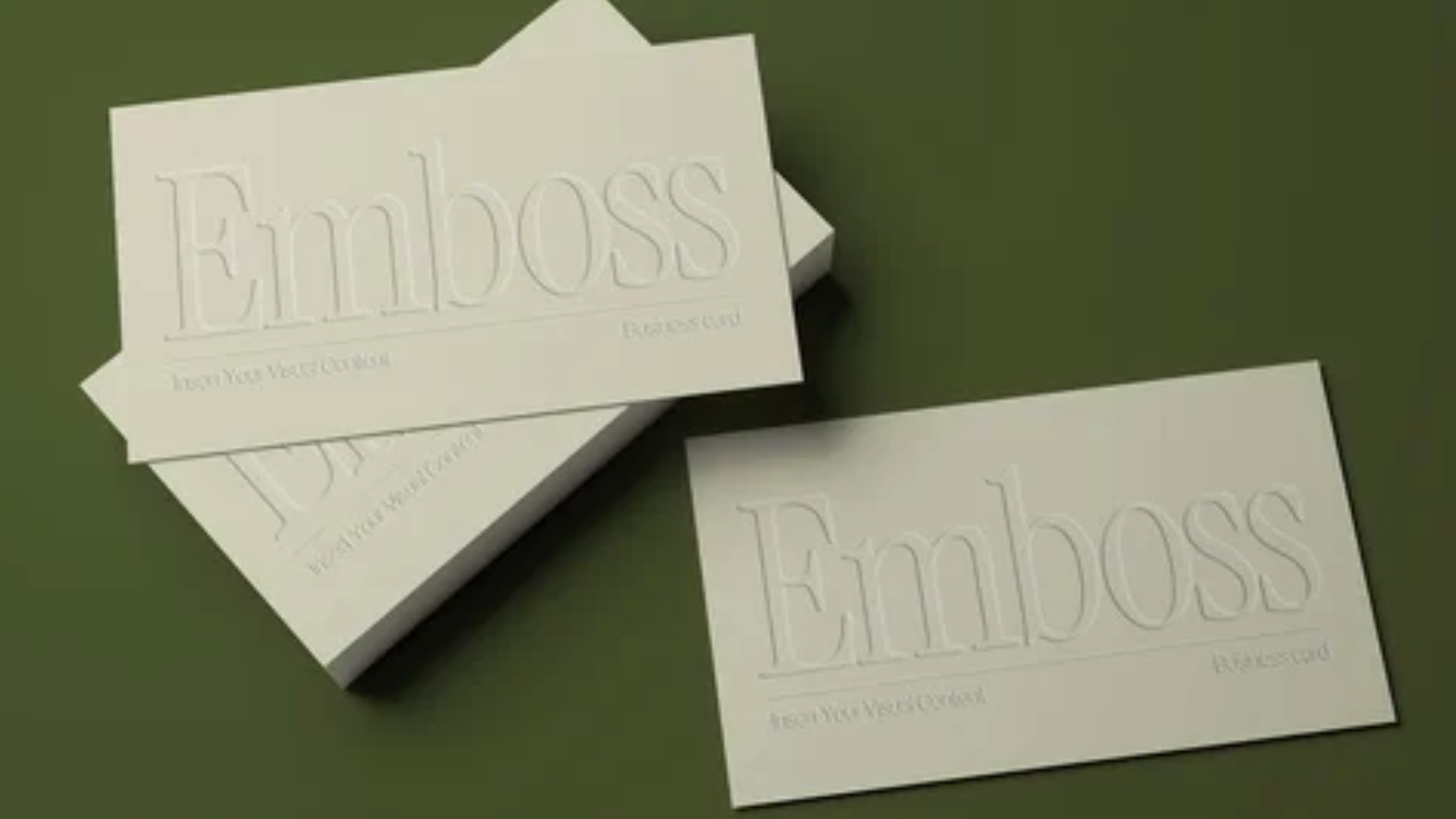
There is something about an embossed business card. You can feel it before you even read it. The raised lettering, the slight ridge under your thumb, the sense that this card was made on purpose. It looks expensive because it is. And that is where the question starts.
Embossed business cards sit at the premium end of the print spectrum. They cost more, take longer to produce, and only really make sense above certain quantities. Pick the wrong moment to use them and you end up with a card that looks beautiful but bites into a marketing budget that should have gone elsewhere. Pick the wrong finish and you get something that looks like embossing in photos but feels flat in the hand.
This guide gives you a straight answer. We cover what embossing actually is, how it differs from modern raised finishes like Scodix and Spot UV, who they make sense for, and how to know whether they are worth it for your specific business. As an experienced Melbourne based print services company that prints raised effect cards every week, we are happy to call it both ways.
By the end, you will know whether your next order of business cards should be embossed, or something simpler that still feels just as premium.
Here's Everything You Need to Know in Under a Minute
Short on time? Here are the points worth remembering.
- Embossed business cards have raised lettering or images created by pressing the paper between two metal dies. The finish is permanent, tactile, and immediately recognisable.
- They are not the same as Spot UV, Scodix, or foil. Each of those gets a raised effect by a different method and at a different cost point.
- Embossing makes economic sense at higher quantities because of the one off cost of producing the metal die.
- For lower quantities or faster turnarounds, Scodix or Spot UV cards deliver a similar tactile result without the tooling cost or wait.
- They suit lawyers, accountants, architects, wealth advisors, luxury brands and wedding stationery. Businesses where craft signals trust.
- The biggest design mistake is embossing too many elements. Keep raised areas to your logo or a single bold word. Less is more.
- Most Australian printers, including The Print Company, achieve the embossed look through digital raised alternatives like Scodix, Spot UV and Metallic Raised cards for everyday volumes.
Table of Contents
- What Are Embossed Business Cards
- How Embossed Cards Compare to Other Premium Finishes
- Are Embossed Business Cards Worth It
- Who Embossed Business Cards Are For
- Design Tips for Embossed Business Cards That Work
- Pairing Embossed Cards With a Wider Print Suite
- Print Ready Setup for an Embossed Card
- How The Print Company Delivers the Embossed Look in Australia
- Frequently Asked Questions
- Your Embossed Business Card Decision Made Simple
What Are Embossed Business Cards
Embossed business cards have parts of the design pressed upwards from the surface of the paper, creating a raised tactile effect. The result is something you can both see and feel. Run your finger over an embossed logo and you will catch the edge of it. Tilt the card under a light and the raised area throws a soft shadow.
Unlike printed cards, where every element sits flat on the page, embossed cards introduce a third dimension. That dimension is what gives them their reputation for craftsmanship and premium quality. Globally, around seven billion business cards are still printed each year, and a growing share at the premium end use raised finishes like embossing to stand apart from the rest.
How Embossing Actually Works
Traditional embossing uses two metal dies. One has the design raised, the other has the same design cut into it. The card is pressed between them. According to Wikipedia's article on paper embossing, the raised die forces the paper stock into the recessed die, permanently pushing the paper fibres up into the shape of the design. The result is a clean raised area that holds its shape forever.
The process uses three controls: pressure, heat, and die depth. Get them right and the raised area is sharp, even, and consistent across the whole print run. Get them wrong and you get blown out shapes, cracked paper, or inconsistent depth from one card to the next. This is why embossing is a finish best left to printers who do it regularly.
Blind Embossing vs Printed Embossing
Blind embossing means the raised area is the same colour as the rest of the card. There is no ink involved. The effect is purely tactile and shows only through light and shadow. It is the most refined and minimal form of embossing.
Printed embossing combines a printed area, often in ink or foil, with the embossing pressed on top. The result is a raised element with colour, which gives it a more obvious visual punch.
Embossed vs Debossed
Embossing pushes the design up. Debossing presses it in. Both use the same kind of die setup, just reversed. Debossed cards have a sunken impression instead of a raised one, and the effect is quieter and more subtle. Debossing is often chosen by minimalist or luxury brands that want the touch of texture without the visual lift.
Embossed vs Letterpress
Letterpress printing was invented around 1440 by Gutenberg, and traditionally aimed for almost no impression on the paper at all. The type was meant to just kiss the surface. Modern craft letterpress, by contrast, deliberately presses the type into the paper, creating a debossed effect with ink in the impression. People sometimes confuse this with embossing, but the two are different. Letterpress is essentially printing with a recessed feel. Embossing is a separate die based process focused entirely on raising the surface.
How Embossed Cards Compare to Other Premium Finishes
Here is where most articles about embossing fall short. They explain what embossing is, then quietly assume it is the right answer. In Australia, you actually have three or four modern raised finishes that achieve a very similar end result, often at a lower cost and faster turnaround. Knowing the difference helps you make a sharper call.
Embossed vs Spot UV
Spot UV is a glossy varnish applied only to specific parts of the card, like your logo or a key word. It sits slightly raised on the paper and creates a strong contrast against the matt finished card around it. It is highly tactile, very visible under light, and faster and cheaper to produce than traditional embossing. The trade off is that the raised effect is less pronounced. Embossing lifts the paper itself, while Spot UV adds a raised varnish on top.
Embossed vs Scodix
Scodix is a digital raised effect that produces a noticeable 3D feel without the cost of a traditional embossing die. The lift is often deeper than Spot UV and more flexible than embossing, because Scodix can produce raised effects of varying heights and over more complex shapes. For most Australian businesses wanting an embossed look without the embossing tooling cost, Scodix is the practical answer.
Embossed vs Metallic Raised
Metallic Raised Business Cards combine a raised effect with a metallic finish, achieving something that looks similar to foil stamped embossing. They are ideal for brands that want both the texture and the shimmer. The result is striking, especially on matt or dark coloured stocks.
Embossed vs Foil Stamping
Foil stamping presses a thin layer of metallic or pigmented film onto the card. Foil is shiny and immediately premium, but is usually flat. Some printers combine foil with embossing to get both colour and lift, which is the most luxurious finish available. It is also the most expensive.
Side by Side Comparison
| Finish | Raised feel | Visual impact | Cost | Min quantity | Best for |
|---|---|---|---|---|---|
| Embossed | Strong, paper based | Subtle | Higher (die tooling cost) | 500+ for value | Luxury, finance, law, weddings |
| Scodix | Strong, digital | Moderate to strong | Mid | 100+ | Premium look at lower quantities |
| Spot UV | Light, glossy | Moderate | Low | 100+ | Everyday premium |
| Metallic Raised | Strong, with shimmer | High | Mid | 100+ | Brands wanting touch and shine |
| Foil only | Flat | High (shiny) | Mid to high | 100+ | Bold premium, no texture needed |
| Foil + Emboss | Strongest, with shimmer | Highest | Highest | 500+ | Ultra premium, rare runs |
Are Embossed Business Cards Worth It
The honest answer is: sometimes. Here is how to know which side you fall on.
When Embossed Is Worth the Spend
Embossed business cards are worth it when:
- Your brand is built on craftsmanship, trust, or premium service
- You are ordering in higher quantities, ideally 500 or more, where the cost of the embossing die is spread across a meaningful number of cards
- You meet clients in formal settings where every detail matters
- Your competitors all use flat printed cards and you want a clear differentiator
- The embossed element is a strong, simple logo or initials, not fine type
When a Digital Raised Alternative Is the Smarter Call
A Scodix or Spot UV finish is the smarter call when:
- You are ordering smaller quantities, say 100 to 300 cards
- You want a faster turnaround without waiting for embossing die tooling
- Your design has fine detail or thin lines that traditional embossing would lose
- You are testing a brand or design and might want to reprint with changes
- You want the tactile premium feel without the premium price
Cost vs Perceived Value
Embossing carries a fixed setup cost for the metal die, plus a per card cost for the press time. That setup cost is paid once. So embossed business cards become more economical as quantity goes up. For a one off order of 100 cards, embossing is usually the most expensive option per unit. For an order of 1,000 or 2,000 cards, the per unit cost drops sharply.
Scodix and Spot UV have no die setup. The per card cost is higher than basic printing, but flat across any quantity. For most Australian small businesses ordering in the 100 to 500 range, this is the more practical maths.
The Quantity Threshold
If you are ordering fewer than 500 cards, a Scodix or Spot UV card delivers most of the perceived premium feel of embossing at a lower total cost. Above 500 cards, traditional embossing starts to compete on price. Above 1,000 cards, embossing often wins outright, especially if the brand calls for the deepest possible tactile finish.
Who Embossed Business Cards Are For
Some industries are made for embossing. Others would be wasting money. Here are the Australian industries where embossed cards genuinely earn their cost.
Lawyers Accountants and Professional Services
Embossing reads as careful, considered, and serious. Three things lawyers and accountants want clients to associate with their work. A clean matt card with the firm logo blind embossed says everything you need it to.
Architects and Design Studios
Architects respect material craft. A card with raised elements demonstrates the same attention to detail you bring to a building. Subtle, simple, with the practice name embossed on a heavy uncoated stock.
Boutique Luxury and Wellness Brands
Day spas, jewellers, boutique fashion labels, luxury skincare. Anything where the product itself is a sensory experience. The card should feel like the brand.
Wealth Advisors and Finance
Trust is the entire product. A card that feels substantial in the hand reinforces the message that your client's money is in equally substantial hands.
Real Estate (Premium Agents)
Premium real estate is about positioning above the average agent. A card that feels different the moment it is handed over makes that case before you have said anything.
Wedding Stationery and Event Planners
Couples planning a wedding are buying into craft and care. Embossed business cards, and matching invitation suites, reinforce that you understand the same level of detail they want for their day.
Design Tips for Embossed Business Cards That Work
Embossing is unforgiving. The design rules are different to flat printed cards, and getting them wrong wastes the entire premium. Here is what to follow.
Keep It Simple
Embossing works best when it highlights one or two elements. Your logo. Your initials. A single bold word. The whole card should not be raised. Too many embossed areas compete with each other and dilute the effect.
Bold Shapes Over Fine Lines
Fine type, thin lines, and small intricate details lose definition when embossed. Use bold geometric shapes, chunky type, and recognisable silhouettes. If your logo has lots of fine detail, consider embossing only the strongest part of it.
Choose the Right Paper Stock
Embossing needs thickness. Thin paper does not hold a clean raised impression and risks cracking under the die. Use heavier stocks like uncoated or artboard cards for the best results. Cotton and recycled stocks also work well.
Balance Embossed and Flat Areas
Leave breathing room around your embossed elements. The flat areas of the card frame the raised areas and make them feel intentional. A card crammed with content gives the embossing nowhere to land.
Common Mistakes to Avoid
- Embossing fine type (anything under 12 pt risks losing definition)
- Embossing too close to the trim edge (raised areas need clearance from the cut line)
- Embossing on thin paper (cracks, distorts, looks cheap)
- Using more than two embossed areas (cluttered, no hierarchy)
- Mixing embossing with heavy ink coverage in the same area (ink can crack under the die pressure)
For deeper design guidance specific to The Print Company's stock and finish options, our business card design page has practical examples to work from.
Pairing Embossed Cards With a Wider Print Suite
Embossed business cards are rarely the only piece of premium print you will hand out. At a partner meeting, a luxury launch, or a wedding consultation, your card is part of a wider brand impression. Matching the finish and feel across your print suite is what locks the premium positioning in.
For information rich follow ups, pair your embossed cards with matching Brochure printing. A brochure that uses the same uncoated stock, matching colour palette and the same embossed logo on the cover ties the experience together. Clients read the consistency as care.
For events, openings and showroom moments, pair your cards with Poster printing. A cohesive premium identity across card, brochure and poster turns a single event into a memorable brand moment.
The premium print suite is also a quiet credibility signal. When every printed thing your business produces feels considered, clients trust the substance behind it.
Print Ready Setup for an Embossed Card
Even a great embossed design fails if the file is not set up correctly. Here is what to get right before sending to press. Our print specifications page covers the detail, but these are the rules most relevant to embossing.
File Formats
Supply a print ready PDF with fonts embedded and CMYK colour. For the embossed area, include a separate vector layer clearly labelled as the emboss area, with no fill colour. Your printer uses this layer to make the die.
Bleed and Safe Area
3 mm bleed on every side as standard. Keep your embossed elements at least 5 mm inside the trim line so the raised area has clearance from the cut.
Choosing the Right Stock Weight
Embossing requires heavier stocks. 350 gsm or higher is a safe floor. 400 gsm and above gives the deepest, cleanest impression. Thinner stocks risk cracking under the die.
Quantity and Cost
Order what you will use in the next 6 to 12 months. For embossed cards, the quantity affects the per unit cost more than it does for printed cards. If you are confident in your brand and design, order at the higher end of your need to spread the die cost.
For the full production walkthrough, our comprehensive guide to business card printing covers every step from file setup to delivery.
How The Print Company Delivers the Embossed Look in Australia
Honest answer first: traditional die embossing is a specialty job. Most everyday business card orders in Australia, even premium ones, are better served by digital raised finishes that deliver the same tactile result without the die tooling cost.
That is why The Print Company built our standard range around the modern raised alternatives. Scodix for deep digital lift on logos and patterns. Spot UV for a raised glossy contrast on a matt finished card. Metallic Raised Business Cards for brands that want both texture and shimmer. Three different ways to achieve the embossed look, all available at low minimum quantities, all delivered Australia wide.
For larger runs where traditional embossing makes economic sense, or for special projects with combined finishes like foil and emboss, our online custom printing services handle the brief from idea to delivery. We will scope the job, recommend the right finish for your quantity and design, and check every file before press at no extra cost.
The full business card printing range covers every direction in this guide. Pick the finish that suits your design, your quantity and your budget, and we will make sure the card you get back is the card you imagined.
Frequently Asked Questions
What Is the Difference Between Embossed and Debossed Business Cards?
Embossed business cards have raised elements that lift up from the surface of the card. Debossed business cards have the design pressed inwards, creating a sunken impression. Both use the same kind of metal die setup, just in opposite directions. Embossed feels bolder and more visible. Debossed feels quieter and more subtle. Choose embossed when you want presence. Choose debossed when you want a minimalist touch of texture.
Are Embossed Business Cards More Expensive Than Regular Cards?
Yes. Embossing carries a one off setup cost for the metal die plus an additional per card press cost. For a small order of 100 to 300 cards, embossed is usually the most expensive option per unit. For larger orders of 1,000 cards or more, the die cost is spread across more units and the per card price comes down significantly. If you want the premium look at lower quantities, a Scodix or Spot UV card delivers a similar tactile feel for less.
Can You Emboss Thin Paper?
No, not well. Embossing relies on the paper having enough body to hold the raised shape cleanly. Thin paper either cracks under the die pressure or springs back flat and loses the impression. For embossed business cards, use a stock of at least 350 gsm. For the deepest, most impressive embossing, 400 gsm or higher works best.
Should I Choose Embossed or Scodix for a Premium Feel?
For most Australian small businesses ordering 100 to 500 cards, Scodix is the smarter call. It produces a deep raised effect, takes no die tooling, prints quickly, and costs less per unit at smaller quantities. Traditional embossing becomes the better value at higher quantities (500 plus) and when you want the deepest possible paper based texture. Both feel premium in the hand. The right choice comes down to your quantity, budget and design.
How Long Do Embossed Business Cards Take to Print?
Embossing usually adds two to five business days to a standard business card print run because the metal die needs to be made and tested before the run can start. Digital raised alternatives like Scodix and Spot UV have no tooling step, so they ship on standard business card turnarounds. If timing matters, ask your printer for both options before committing.
Your Embossed Business Card Decision Made Simple
Embossed business cards are not for every business. They are a premium choice that rewards the right brand, the right quantity and the right design. For lawyers, architects, wealth advisors, luxury brands and event planners ordering 500 or more cards, embossing delivers a tactile premium that is hard to beat.
For most other Australian small businesses, a Scodix, Spot UV or Metallic Raised card delivers the same premium feel at a more practical cost. There is no wrong answer. There is only the answer that suits your brand and your budget.
Ready to print? The Print Company are Melbourne based specialists in professional print, delivering business cards Australia wide, with every file checked before press at no extra cost. Great print, made easy.
Prefer a tailored price? Give us a call on 03 8679 4587 or get in touch for a personalised quote.
